Independent Runtime Governance Verification
AGCP Conformance validates whether an implementation satisfies the deterministic runtime governance requirements defined by the AGCP specification.
Conformance evaluates observable runtime governance behavior including:
- runtime admissibility enforcement
- execution-bound authorization
- deterministic governance mediation
- evidence continuity
- replayability
- tenant isolation
- operational governance integrity
Organizations may:
- independently implement AGCP
- align existing governance architectures internally
- work with third-party implementation partners
- optionally engage AGCP advisory services prior to evaluation
WHAT CONFORMANCE MEANS
Runtime Governance Verification
AGCP Conformance evaluates whether runtime governance behavior conforms to the governance semantics defined by the AGCP specification.
Conformance focuses on observable runtime behavior including:
- lifecycle integrity
- governance mediation ordering
- policy and constraint enforcement
- admissibility evaluation
- HITL authorization integrity
- execution gating
- replay determinism
- governance evidence consistency
- tenant isolation behavior
Conformance does not evaluate:
- model quality
- AI ethics scoring
- enterprise cybersecurity maturity
- regulatory compliance maturity
- model-training methodology
- generalized AI governance posture
OPEN IMPLEMENTATION MODEL
Open Governance Architecture
AGCP is an open runtime governance specification.
Conformance does not require:
- proprietary AGCP implementation tooling
- AGCP-managed infrastructure
- AGCP-developed software
- AGCP advisory participation
Assessment targets may:
- implement AGCP internally
- align existing governance systems to AGCP semantics
- expose implementation-specific APIs
- integrate AGCP behavior through third-party governance platforms
Conformance evaluates governance behavior through mapped runtime semantics and supervised runtime validation rather than requiring identical implementation structures or endpoint models.
FUNCTIONAL CONFORMANCE MODEL
Behavior-Based Governance Validation
AGCP Conformance evaluates runtime governance behavior rather than implementation-specific software composition.
Conformance does not require:
- AGCP runtime libraries
- AGCP SDK integration
- AGCP-managed middleware
- AGCP-specific orchestration platforms
- proprietary AGCP execution components
Assessment targets may implement equivalent governance behavior using internally developed systems, third-party infrastructure, existing orchestration environments, or custom runtime governance architectures.
Conformance evaluation focuses on whether the assessed system correctly enforces AGCP governance semantics including:
- runtime admissibility evaluation
- ordered governance mediation
- execution-bound authorization
- deterministic lifecycle behavior
- replay integrity
- governance evidence continuity
AGCP Conformance therefore operates as a functional runtime governance assessment rather than a software-dependency certification model.
IMPLEMENTATION REVIEW & CODE ANALYSIS
Optional Implementation Inspection
AGCP Conformance primarily evaluates observable runtime governance behavior through functional assessment and supervised runtime validation.
However, implementation inspection and repository analysis may optionally be incorporated into the assessment process to:
- validate governance implementation integrity
- improve assertion-mapping accuracy
- verify lifecycle enforcement mechanisms
- assess replay implementation consistency
- evaluate governance-control placement
- strengthen conformance confidence
Implementation review activities may include:
- repository inspection
- governance code-path review
- lifecycle enforcement analysis
- authorization-flow analysis
- trace-generation validation
- replay-mechanism review
- governance artifact correlation
When implementation inspection is performed, repository analysis may occur either:
- within AGCP-controlled external assessment environments intended for conformance evaluation activities
- within customer-controlled AI and repository-analysis environments, provided sufficient repository and contextual access is available to support effective governance evaluation
Assessment repositories, source code, artifacts, and implementation materials are not used for AI model training purposes.
AGCP works with assessment targets to:
- minimize unnecessary code exposure
- prevent unintended disclosure of proprietary implementation details
- support controlled repository access
- preserve governance evidence integrity
- maintain controlled assessment conditions throughout the conformance process
Assessments performed without implementation inspection or repository review may be designated as:
- Limited Conformance Assessments
- Limited Scope Reviews
- Runtime-Only Assessments
depending on assessment scope and available evidence.
Assessment reports may identify whether implementation-level analysis was included as part of the conformance process and whether the assessment was:
- runtime-only
- limited-scope
- implementation-informed
- customer-environment-assisted
- externally assessed
CONFORMANCE LEVELS
AGCP Conformance Levels represent progressively stronger runtime governance guarantees and verification depth.
LEVEL 1 — SCHEMA & ENVELOPE VALIDATION
Verifies:
- AGCP schema compliance
- envelope integrity
- required metadata handling
- structured rejection semantics
- interoperable governance message structure
LEVEL 2 — ORDERED GOVERNANCE MEDIATION
Verifies:
- deterministic evaluation ordering
- policy resolution sequencing
- constraint and invariant evaluation
- governance decision recording
- rejection behavior consistency
- governance mediation integrity
LEVEL 3 — DETERMINISTIC GOVERNANCE
Verifies:
- replayable governance behavior
- deterministic decision consistency
- invariant preservation
- reproducible governance outcomes
- deterministic governance enforcement
LEVEL 4 — EXECUTION AUTHORIZATION CONTROL
Verifies:
- HITL enforcement integrity
- quorum and cosign enforcement
- execution authorization gating
- execution commit validation
- execution-bound governance mediation
LEVEL 5 — MULTITENANT GOVERNANCE ISOLATION
Verifies:
- tenant isolation enforcement
- cross-tenant access protection
- governance namespace isolation
- multitenant governance integrity
- tenant-scoped execution mediation
CONFORMANCE TESTING
Assertion-Driven Validation
AGCP Conformance uses:
- normative assertions
- deterministic test vectors
- lifecycle transition validation
- runtime execution traces
- replay verification
- governance evidence analysis
- rejection-path validation
to verify runtime governance behavior against the AGCP specification.
Assessment targets may expose implementation-specific:
- APIs
- execution surfaces
- governance pipelines
- authorization models
- operational architectures
Conformance validation evaluates externally observable governance behavior and runtime semantics rather than requiring implementation-specific software dependencies or embedded AGCP runtime components.
Conformance evaluates governance behavior through mapped runtime semantics and supervised runtime validation rather than requiring identical implementation structures or endpoint models.
SUPERVISED CONFORMANCE EXECUTION
Observed Runtime Governance Validation
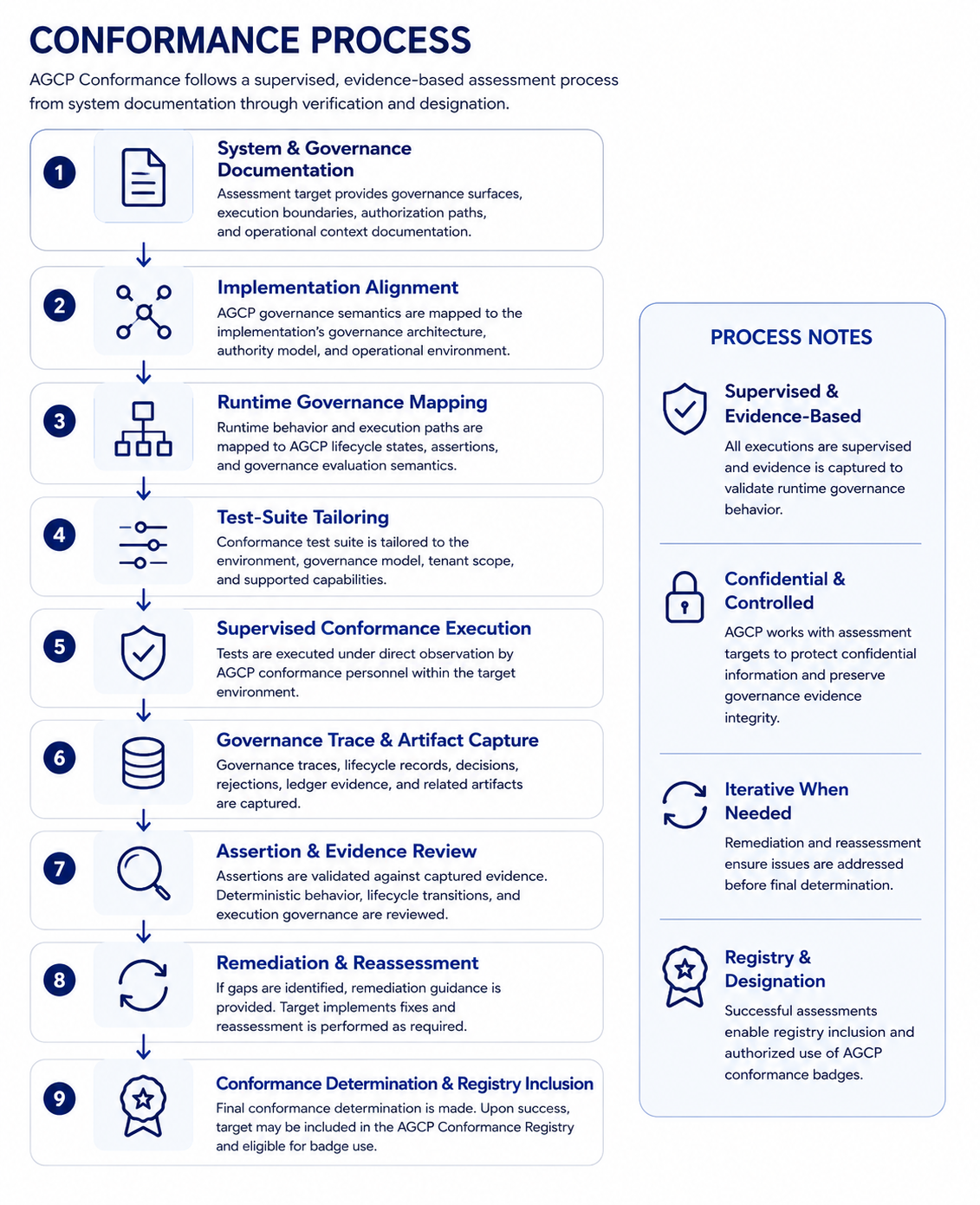
AGCP Conformance is performed through supervised runtime governance evaluation using tailored conformance test suites executed within the assessment target’s operational environment.
Assessment activities include:
- target-specific test-suite tailoring
- runtime governance mapping
- controlled test execution
- governance trace generation
- lifecycle validation
- replay verification
- artifact capture
- governance evidence review
Conformance execution is performed under direct observation by AGCP conformance personnel to validate:
- runtime governance behavior
- execution authorization integrity
- rejection semantics
- evidence continuity
- deterministic governance operation
Captured artifacts may include:
- governance traces
- lifecycle records
- execution decisions
- rejection events
- ledger evidence
- replay outputs
- conformance validation records
GOVERNANCE TRACE VALIDATION
Operational Governance Evidence
Conformance assessment evaluates runtime governance traces including:
- lifecycle transitions
- admissibility decisions
- governance mediation ordering
- HITL workflows
- execution authorization
- execution commit validation
- rejection handling
- replay behavior
- cross-tenant isolation
- governance evidence continuity
Representative trace families include:
- SUBMITTED → AUTHORIZED
- SUBMITTED → PENDING_HITL
- SUBMITTED → REJECTED
- PENDING_HITL → AUTHORIZED
- PENDING_HITL → REJECTED
- AUTHORIZED → EXECUTED
- replay rejection paths
- execution authorization failures
- cross-tenant access rejection paths
GOVERNANCE ARTIFACT HANDLING
Confidentiality, Redaction & Evidence Retention
AGCP Conformance assessments may involve operational governance artifacts containing confidential, proprietary, regulated, or security-sensitive information.
Assessment targets may redact:
- proprietary implementation details
- confidential operational data
- protected tenant information
- internal identifiers
- sensitive infrastructure references
- regulated business information
provided the resulting artifacts remain sufficient to validate runtime governance behavior and conformance assertions.
AGCP Conformance personnel work with assessment targets to:
- minimize unnecessary data exposure
- support appropriate artifact sanitization
- preserve governance trace integrity
- maintain evidentiary continuity throughout the assessment process
Captured governance artifacts, traces, replay records, lifecycle evidence, and conformance validation outputs are retained by AGCP as part of the formal conformance record.
AGCP maintains administrative, operational, and technical safeguards intended to protect retained conformance evidence from unauthorized disclosure, modification, or access.
Artifact retention supports:
- conformance verification integrity
- replay and audit validation
- dispute resolution
- registry substantiation
- longitudinal governance assurance review
GOVERNANCE LIFECYCLE VERIFICATION
Lifecycle Integrity
AGCP Conformance verifies that implementations correctly enforce normative governance lifecycle semantics.
Assessment includes validation of:
- permitted lifecycle transitions
- terminal-state enforcement
- deterministic state derivation
- ordered ledger semantics
- replay-safe execution behavior
- governance evidence continuity
Lifecycle state must remain derivable from governance evidence and operational trace history.
EXECUTION GOVERNANCE VALIDATION
Bind-Time Governance Enforcement
AGCP evaluates whether consequential execution is correctly mediated at runtime authorization boundaries.
Conformance assessment validates:
- execution authorization requirements
- runtime admissibility enforcement
- authorization-reference integrity
- execution replay rejection
- rejection-path consistency
- governance-controlled execution gating
Execution authority must remain valid under current runtime governance conditions at the point of consequential execution.
ASSESSMENT TARGET DOCUMENTATION
Governance Surface Mapping
Conformance assessment begins with documentation of the operational system under evaluation, including:
- governance surfaces
- execution boundaries
- runtime authorization paths
- lifecycle ownership
- operational dependencies
- tenant scope
- governance-controlled execution domains
This information is used to map AGCP governance semantics to the implementation-specific operational environment and tailor the conformance test suite accordingly.
CONFORMANCE REGISTRY
Public Verification Registry
Organizations that successfully complete AGCP Conformance may optionally participate in the AGCP Conformance Registry.
Registry entries may include:
- supported conformance levels
- validated governance capabilities
- implementation profiles
- governance trace characteristics
- verification scope
- authorized conformance badge designation
- conformance status
Registry participation is optional.
Confidential governance artifacts and retained conformance evidence are not publicly disclosed through registry participation.
Registry participants may optionally authorize publication of designated conformance reports, summaries, or validated governance findings.
CONFORMANCE MARKS & BADGES
Verified Conformance Designations
Organizations that successfully complete AGCP Conformance may be authorized to use AGCP conformance badges and related designation marks identifying the verified conformance level achieved during assessment.
AGCP conformance designations indicate successful completion of the applicable runtime governance assessment scope and should not be interpreted as generalized regulatory, cybersecurity, or legal certification.
Badge designations may include:
- Level 1 Conformant
- Level 2 Conformant
- Level 3 Conformant
- Level 4 Conformant
- Level 5 Conformant
Authorized badge usage may apply to:
- corporate websites
- governance documentation
- procurement responses
- audit materials
- implementation documentation
- product materials
- operational governance disclosures
Conformance badges indicate that the assessed implementation successfully completed the corresponding AGCP conformance evaluation scope at the time of assessment.
Conformance designation rights are contingent upon:
- successful completion of the assessment process
- adherence to AGCP designation-use requirements
Unless otherwise specified within the assessment agreement or registry designation terms, conformance assessments are not required to be performed periodically to maintain use of the designation. However, the Registry will include the date of the last assessment.
CONFORMANCE REPORTING
Formal Conformance Assessment Reports
AGCP Conformance assessments produce formal conformance reports documenting the scope, results, observations, and governance findings associated with the assessment process.
Conformance reports may include:
- assessed operational components
- evaluated governance surfaces
- assessed conformance level(s)
- assertion and trace-validation outcomes
- lifecycle validation findings
- replay and execution-governance observations
- governance evidence notations
- implementation-review scope designation
- runtime-only or implementation-informed assessment designation
- authorized conformance designation status
- final conformance determinations
Assessment findings may identify:
- Fully Met
- Partially Met
- Not Met
- Informational Observations
for evaluated governance requirements and conformance assertions.
Reports may also include:
- implementation-specific assessment notes
- governance boundary clarifications
- environmental limitations
- operational assumptions
- artifact-handling notes
- replay or trace-validation observations
Formal conformance reports are retained as part of the AGCP conformance evidence record and may support:
- internal governance review
- enterprise assurance activities
- regulatory or audit support processes
- vendor governance validation
- procurement review
- operational governance substantiation
Organizations participating in the AGCP Registry may optionally authorize publication or downloadable distribution of designated conformance reports or summary findings through the AGCP Registry.
Sample conformance reporting templates and example assessment summaries will be made available as the AGCP ecosystem expands.
OPEN SPECIFICATION
Open Runtime Governance Standard
AGCP is developed as an open runtime governance specification intended to support interoperable governance mediation across AI-enabled enterprise and autonomous operational systems.
The specification includes:
- normative lifecycle semantics
- governance schemas
- assertion registries
- deterministic test vectors
- rejection registries
- governance evaluation mappings
- runtime governance reference architectures
TOWARD VERIFIABLE EXECUTION GOVERNANCE
As AI-enabled systems become increasingly operationally consequential, governance architectures must support observable, testable, and replayable runtime governance behavior.
AGCP Conformance establishes a formal framework for validating deterministic runtime execution governance across distributed enterprise operational environments.