Runtime Governance Architecture for AI and Autonomous Systems
AGCP is a deterministic governance execution control plane positioned between proposed consequential action and operational execution.
AI-enabled, agentic, autonomous, multi-agent, and programmatic systems may reason, recommend, coordinate, and propose actions. AGCP provides the deterministic governance layer that determines whether a proposed action may become operationally real under current governing conditions.
The architecture separates probabilistic reasoning from deterministic authorization and enforcement, preserving explicit authority, admissibility, lifecycle state, evidence, and execution boundaries.
Static Governance Does Not Control Runtime Execution
Traditional governance approaches primarily establish policy, approve systems, provision access, monitor behavior, and review outcomes. Those functions remain necessary, but they do not by themselves govern each consequential state transition at the moment of execution.
AI Systems Can Propose and Initiate
- operational workflows
- tool and API invocation
- infrastructure changes
- multi-agent coordination
- security actions
- financial or business-process actions
Governance Must Determine
- whether the actor has authority
- whether the proposed action is admissible
- whether mandatory constraints are satisfied
- whether required evidence is present
- whether approvals remain valid
- whether execution may proceed now
AGCP treats governance as a runtime control problem over proposed consequential state transitions—not merely as a policy, monitoring, or post-event audit problem.
From Governance Intent to Governed Execution
AGCP operates within a larger runtime-governance architecture. Governance intent is defined and compiled upstream. AGCP consumes the resulting machine-evaluable governance artifacts and applies them to proposed consequential actions at runtime.
Governance compilation and governance execution are distinct functions. AGCP does not replace policy authoring or governance compilation. It provides deterministic runtime evaluation, authorization, lifecycle control, and evidence generation using the applicable compiled governance artifacts.
Runtime Governance Architecture
The reference architecture separates governance definition and compilation from runtime governance execution and operational realization.
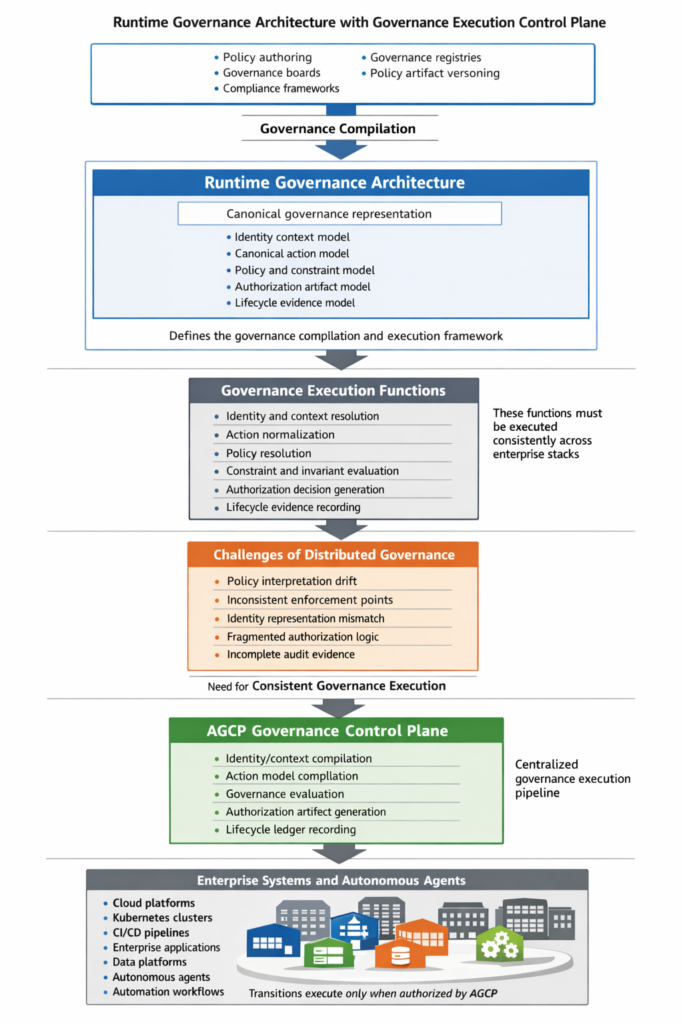
The diagram illustrates architectural responsibilities and information flow. AGCP is implementation-agnostic and does not require one prescribed infrastructure, middleware, orchestration platform, or execution engine.
Probabilistic Components Propose. Deterministic Components Commit.
AGCP does not require AI reasoning itself to become deterministic. Probabilistic components may analyze context, generate alternatives, recommend actions, or construct proposals.
Those components do not establish their own authority to create consequential operational effects. The transition from proposal to operational consequence is mediated by deterministic governance logic.
Probabilistic Components
- reason
- analyze
- generate
- rank
- recommend
- propose
Deterministic Governance Components
- resolve applicable authority
- evaluate admissibility
- enforce mandatory constraints
- authorize or refuse execution
- control lifecycle transitions
- generate governance evidence
Deterministic Runtime Governance
Proposal Is Not Authority
A model, agent, workflow, or application may propose an action without possessing authority to make that action operationally real.
Deterministic Mediation
Equivalent governance inputs and governing conditions should produce reproducible governance outcomes.
Execution-Bound Authorization
Authorization is tied to the specific proposed action and remains valid only while the governing conditions supporting it remain valid.
Current-State Evaluation
Admissibility derives from current canonical state rather than relying solely on an earlier approval or historical state.
Evidence Continuity
Governance intent, evaluation, authorization, execution, and outcome should remain attributable through appropriate evidence and provenance.
Implementation Independence
AGCP defines governance semantics and requirements without mandating AGCP-managed middleware, SDKs, orchestration, or execution engines.
Authorization Must Still Be Valid When Execution Becomes Real
A proposal may be evaluated or even conditionally authorized before execution occurs. That authorization does not create unconditional future execution authority.
Between proposal and commitment, governing conditions can change:
- authority may expire or be revoked
- tenant or system status may change
- policy may change
- canonical state may change
- required evidence may become stale or invalid
- an approval may expire
- a mandatory invariant may cease to be satisfied
Where governing assumptions can change, the proposed transition must be re-evaluated against current conditions before consequential execution is committed.
How AGCP Mediates a Proposed Consequential Action
Receive Proposal
Receive a proposed consequential action together with its actor, provenance, requested scope, and available context.
Resolve Identity & Context
Establish the relevant actor, tenant, delegated authority, operational context, and other governance subjects.
Normalize the Action
Express the requested operation in a canonical form suitable for deterministic governance evaluation.
Resolve Applicable Governance
Identify the policies, constraints, invariants, approvals, evidence requirements, and authority rules that govern the proposal.
Evaluate Admissibility
Determine whether the proposed transition is permitted under current canonical state and applicable governance conditions.
Authorize, Escalate, or Refuse
Produce the deterministic governance disposition required by policy, including escalation or human adjudication where applicable.
Revalidate at Commitment
Confirm that the authorization and the assumptions supporting it remain valid when the action reaches the execution boundary.
Enforce the Decision
The enforcement point permits or blocks operational realization according to the valid governance disposition.
Record Evidence
Preserve attributable lifecycle, authorization, execution, outcome, and provenance evidence for audit and reconstruction.
The Policy Enforcement Point and Non-Bypassability
AGCP produces governance decisions and authorization artifacts. The applicable Policy Enforcement Point (PEP) controls whether the proposed action may cross the operational execution boundary.
The PEP Requires
- the applicable authorization artifact
- the governed action identity
- the relevant execution context
- current governance information required for admissibility
- binding between authorization and the specific action executed
Non-Bypassability Requires
- governed execution paths routed through the enforcement point
- no alternate path capable of creating the same governed effect
- execution authority unavailable without valid governance authorization
- deployment and configuration evidence supporting the enforcement claim
Non-bypassability is not established merely because a PEP exists in application code. It depends on the execution target and deployment architecture actually requiring governed transitions to pass through the enforcement path.
Explicit Governance State
AGCP preserves explicit lifecycle semantics so that internal processing, authorization state, escalation, rejection, expiration, and execution do not collapse into ambiguous workflow status.
Proposed / Pending
The action has not yet obtained authority to become operationally real. Pending evaluation must not permit execution.
Escalated
Additional adjudication, quorum, approval, or human authorization is required before an authorization outcome can be reached.
Authorized
Applicable governance conditions are satisfied and a specific authorization artifact may permit execution while its governing assumptions remain valid.
Rejected / Terminated
The proposed transition is not permitted and must not become operationally real.
Expired / Invalidated
Previously valid approval or authority no longer satisfies the conditions required for execution.
Executed
The authorized transition has crossed the commit boundary and should be recorded as a non-ambiguous operational outcome.
Governance Must Be Reconstructable
AGCP treats evidence as part of runtime governance rather than merely as an after-the-fact audit product.
Provenance
Proposed actions and relevant probabilistic components can be tied to attributable provenance identifiers and governance subjects.
Decision Evidence
Governance records can preserve the policies, constraints, state, approvals, evidence, and authority used in the decision.
Execution Evidence
The operational result can be linked back to the authorization and governed action that permitted it.
This supports auditability, deterministic replay of governance decisions, provenance continuity, and reconstruction of the decision-to-action path.
AGCP Defines Semantics, Not One Required Technology Stack
AGCP is designed to govern heterogeneous enterprise systems without requiring organizations to replace existing orchestration, infrastructure, policy, identity, or execution technologies.
AGCP Does Not Require
- AGCP-managed infrastructure
- AGCP-managed orchestration
- proprietary AGCP runtime middleware
- AGCP SDKs
- one prescribed policy engine
- one prescribed execution platform
Implementations May Use
- existing enterprise applications
- cloud and infrastructure platforms
- agent frameworks
- workflow and orchestration systems
- policy and identity technologies
- independently developed enforcement mechanisms
Conformance is evaluated against applicable AGCP requirements and demonstrated governance behavior, not against the use of AGCP-branded software or one internal implementation pattern.
From Architecture to Assessable Runtime Governance Capability
The AGCP Requirements Catalog translates the architecture into normative runtime-governance requirements covering lifecycle behavior, execution governance, evidence, authority, refusal and escalation, isolation, continuity, interoperability, multi-agent governance, governance compilation interfaces, and control-plane integrity.
AGCP assessment pathways evaluate implementations within a defined scope. Conformance depth, Capability Profile, assessment status, and Registry publication are represented separately so that claims remain bounded to what was actually demonstrated.
Open Runtime Governance Architecture
AGCP is being developed as an open specification, runtime-governance architecture, requirements framework, assessment ecosystem, and interoperability model for governed AI-enabled execution.
- open architectural and semantic specifications
- public normative requirements
- implementation diversity
- interoperable governance semantics
- deterministic runtime validation
- evidence-linked governance
- structured assessment and conformance
Selected AGCP governance architectures, runtime enforcement methodologies, and conformance mechanisms are patent pending.
Govern the Decision-to-Action Pathway
AGCP provides the deterministic runtime governance layer between proposed consequential action and operational execution—connecting governance intent to admissibility, authorization, enforcement, and attributable evidence.