Open Runtime Governance Resources
Specifications, research, requirements, training, assessment guidance, reference architectures, and implementation resources for deterministic runtime governance.
AGCP resources support practitioners working to understand, design, implement, evaluate, and assess runtime governance for AI-enabled, agentic, autonomous, multi-agent, and programmatic systems.
Start with the Material That Matches Your Objective
Understand the Architecture
Start with the Framework and foundational research to understand governance compilation, runtime mediation, the commit boundary, deterministic authorization, and evidence continuity.
View Framework →Implement AGCP Semantics
Use the public specification, Requirements Catalog, operating model, sequence references, and architecture materials to guide implementation.
View Requirements →Prepare for Assessment
Review assessment designations, applicable requirements, Capability Profile concepts, evidence expectations, and assessment pathways.
Assessment & Conformance →Learn Runtime Governance
Use the free self-paced training pathway, six core readings, video briefings, knowledge checks, and the integrated Learning Guide.
Explore Training →Foundational AGCP Runtime Governance Materials
These materials define the architecture, normative governance semantics, lifecycle behavior, execution controls, runtime state model, and deterministic governance concepts underlying AGCP.
AGCP: A Deterministic Execution-Layer Governance Control Plane for Autonomous and Programmatic Systems
Defines the foundational AGCP runtime-governance architecture, including execution-bound authorization, deterministic governance mediation, lifecycle enforcement, and commit-bound execution semantics.
Artificial Intelligence Governance Control Plane (AGCP) Specification v1.0.0
Normative AGCP specification defining governance semantics, lifecycle behavior, execution-governance structures, schema models, interoperability requirements, and deterministic governance constraints.
Live repository: github.com/jwillisSFT/agcp-spec
Runtime Governance Architecture: Consistent Governance Execution for Enterprise Systems and Autonomous Agents
Describes the broader runtime-governance architecture for maintaining consistent governance behavior across heterogeneous enterprise and autonomous systems, including governance compilation and execution-time mediation.
Formal Execution Semantics and Safety Invariants for Governance Control Planes in Autonomous Systems
Defines formal execution semantics, lifecycle invariants, admissibility guarantees, and governance safety properties for deterministic runtime-governance systems.
Conceptual and Semantic Orientation
These resources provide progressively deeper framing of the runtime governance problem, architecture, vocabulary, and operating semantics.
Runtime Execution Governance for AI Systems: A Cross-Platform Synthesis and Architectural Framework
Introduces execution-governance architecture patterns, the proposed consequential action as the governance object, deterministic enforcement around probabilistic AI, governance compilation, and the commit boundary.
AI Runtime Governance: Vocabulary – Walkthrough Style
Accessible walkthrough of runtime-governance terminology, lifecycle semantics, admissibility concepts, execution-governance vocabulary, and operational governance distinctions.
AGCP Operating Model and Semantic Architecture: Proposal Schemas, Governance Context, Canonical State, and Commit-Bound Execution Semantics for Autonomous Systems
Defines proposal structures, governance-context propagation, canonical state, execution-bound validation, authorization semantics, lifecycle evidence, and deterministic execution control.
Secure-by-Design, Runtime Assurance, and Standards Alignment
Operationalizing Secure-by-Design AI Through Deterministic Runtime Governance
Examines why Secure-by-Design AI requires governance mechanisms at the point where proposed consequential actions transition into execution.
The paper develops a deterministic runtime-governance architecture centered on the commit boundary, including admissibility evaluation, execution-bound authorization, canonical-state validation, structural refusal, evidence continuity, replayability, and runtime assurance.
It also maps runtime-governance capabilities to major governance, cybersecurity, AI-risk, secure-by-design, and regulatory frameworks and includes implementation considerations and critical-infrastructure use cases.
AGCP Runtime Governance Requirements Catalog
The public Requirements Catalog defines the normative requirements used to evaluate applicable AGCP runtime-governance behavior.
Lifecycle & Execution
Governance lifecycle state, admissibility, authorization, refusal, escalation, commit control, and execution integrity.
Evidence & Authority
Provenance, evidence continuity, human authorization, delegation, authority lineage, tenant isolation, and auditability.
Advanced Governance
Multi-agent governance, continuity, interoperability, metrology, composite proposals, governance compilation, and control-plane integrity.
Governance Evaluation and Architecture Resources
Execution-Governance Architecture Positioning & Evaluation Form (v1.0)
Structured evaluation framework for assessing governance architectures against AGCP-aligned execution-governance concepts, runtime semantics, deterministic execution controls, and governance mediation capabilities.
Implementation alignment does not require AGCP-specific software. AGCP is implementation-agnostic and evaluates governance semantics, behavior, evidence, and applicable execution-control properties rather than requiring one prescribed internal architecture.
Lifecycle and Operational Flow Materials
AI Governance Lifecycle Sequence Diagram
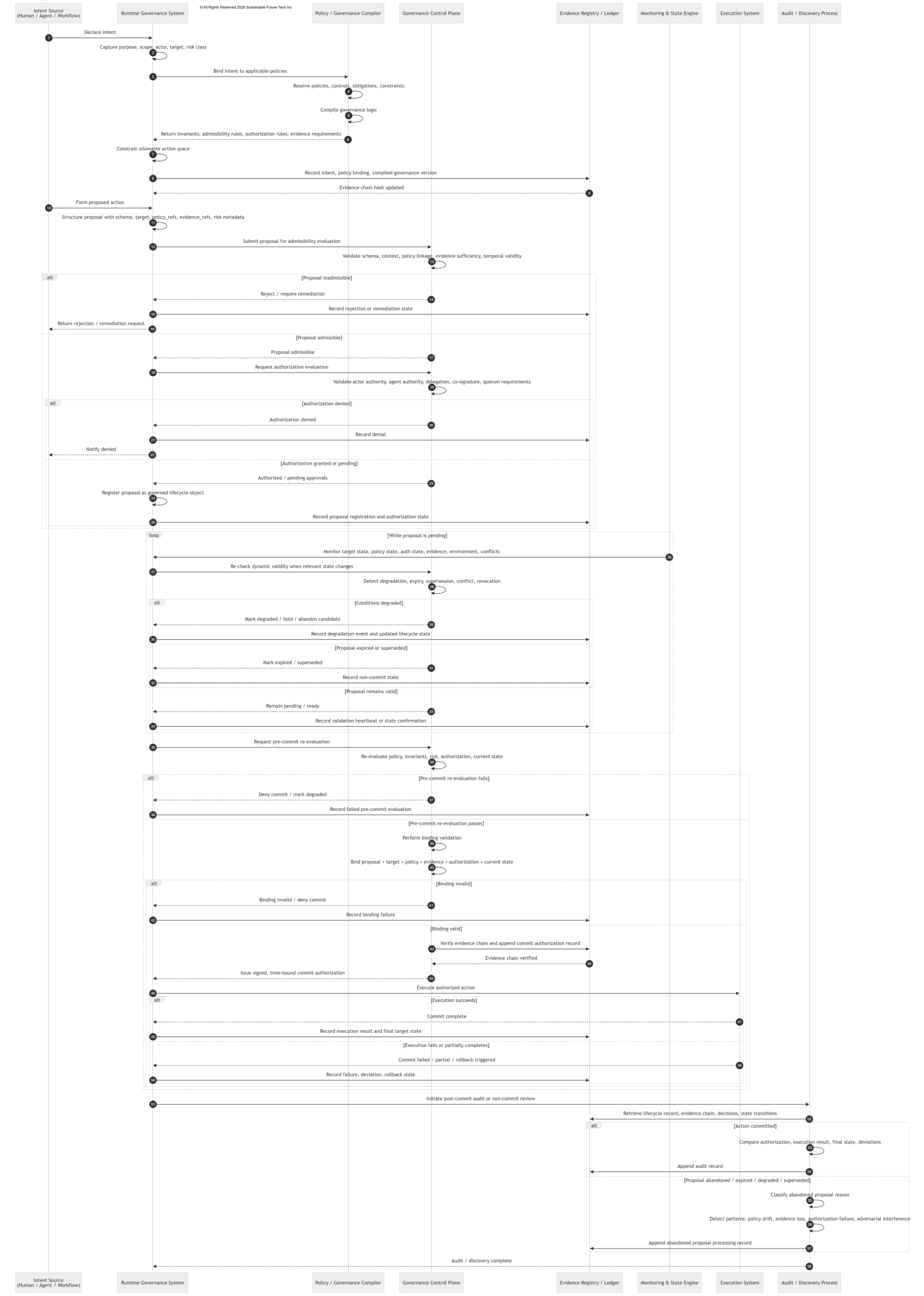
Visual lifecycle model showing deterministic governance transitions, authorization checkpoints, execution boundaries, and evidence-linked execution flow.
AI Governance Lifecycle Sequence Diagram – Description of Steps
Detailed walkthrough of the sequence model, including state transitions, validation boundaries, and operational governance checkpoints.
Example Governance-Aligned Architectures
Reference architectures illustrate how AGCP governance semantics can be incorporated into broader enterprise and multi-agent systems. They are illustrative implementation models rather than normative AGCP requirements.
The PBSAI Governance Ecosystem: A Multi-Agent AI Reference Architecture for Securing Enterprise AI Estates
Illustrates a multi-agent enterprise architecture incorporating deterministic runtime governance, lifecycle validation, execution mediation, evidence continuity, and AGCP-aligned governance semantics across complex AI environments.
Free Runtime Governance Learning Resources
AGCP provides a self-paced learning pathway built directly on the foundational research.
AGCP Runtime Governance Training
Six core readings, two orientation resources, companion video briefings, paper-specific knowledge checks, and an assessment readiness diagnostic.
Begin the Training Pathway →AI Runtime Governance Learning Guide
A 204-lesson source-grounded study guide organized across the six core papers, with source references and links to corresponding knowledge checks.
Open the Learning Guide →Training quizzes and the readiness diagnostic are educational tools. They do not establish an AGCP assessment result or conformance designation.
Current Runtime Governance Assessment Resources
AGCP now provides defined assessment pathways, public conformance definitions, normative requirements, and an optional Registry publication model. These are active resources rather than future planned materials.
Assessment & Conformance
Understand AGCP Registry Assessed, Registry Listed, Human Verified, Assurance Assessed, Capability Profile, conformance depth, and the distinction between assessment and public Registry status.
View Conformance Definitions →AGCP Governance Registry
Review how assessed systems may be represented publicly, what Registry metadata may contain, and how Registry status remains separate from assessment status and capability coverage.
Explore the Registry →Human Verified Assessment
Review the deeper technical assessment pathway using private AI-assisted source-code semantic analysis, supporting evidence, customer-assisted verification, and human adjudication.
Explore Human Verified Assessment →Founders Cohort and October 2026 Registry Publication
The inaugural ten-member AGCP Founders Cohort is complete and scheduled for publication through the AGCP Governance Registry in October 2026. Commercial assessment pathways are available independently of Founders Cohort participation.
Founders Cohort
Review the inaugural assessment cohort, program status, assessment outputs, capability classification model, and planned Registry publication.
View Founders Cohort →Registry Assessment
Automated evidence-based assessment of one defined system against applicable AGCP requirements, producing assessment findings and a governance Capability Profile.
View Assessment Details →Registry Publication
Public Registry publication is optional and separate from assessment. Registry records contain approved assessment, scope, capability, and verification metadata rather than the underlying assessment report or technical evidence.
Understand Registry Publication →Interoperable Runtime Governance Development
AGCP is intended to support interoperable runtime governance across heterogeneous AI-enabled operational environments.
Operational Environments
- enterprise orchestration systems
- multi-agent operational environments
- autonomous execution systems
- governance mediation platforms
- distributed AI-enabled operational ecosystems
Ecosystem Objectives
- governance interoperability
- governance transparency
- operational consistency
- deterministic runtime validation
- evidence-linked execution governance
- implementation-independent alignment
AGCP Resource and Assessment Questions
Does AGCP require proprietary software?
No. AGCP is implementation-agnostic and does not require AGCP-managed infrastructure, orchestration tooling, SDKs, runtime middleware, or proprietary governance libraries.
Can AGCP be integrated with existing systems?
Yes. AGCP governance semantics are designed to support heterogeneous operational architectures, existing enterprise systems, third-party orchestration, and independently developed enforcement mechanisms.
Is AGCP a cybersecurity or regulatory certification?
No. AGCP focuses specifically on runtime-governance capability, execution-control semantics, governance evidence, and applicable conformance requirements. It does not certify generalized cybersecurity maturity, legal compliance, model quality, or regulatory compliance.
Does AGCP require replacing orchestration platforms?
No. AGCP evaluates governance behavior and execution semantics rather than requiring one operational stack or orchestration platform.
What is the difference between assessment and conformance?
An assessment is an evaluation activity performed against a defined system and scope. Conformance describes the demonstrated depth of applicable AGCP runtime-governance capability. Assessment status, conformance depth, Capability Profile, and Registry publication are represented separately.
Does completing an assessment require public Registry publication?
No. Registry publication is optional and separate from assessment. An organization may complete an assessment and retain its results privately.
Does the Registry publish assessment reports or technical evidence?
No. Assessment reports and supporting evidence remain under the control of the assessed organization. A Registry entry may contain approved assessment and capability metadata and, when provided, a report hash that can be used to validate a report supplied separately by the system owner.
Are assessment evidence and governance artifacts retained?
Evidence handling depends on assessment scope, the applicable assessment pathway, confidentiality requirements, and the engagement terms. Evidence used for assessment is not automatically published through the AGCP Registry.
Can AGCP support multi-agent operational systems?
Yes. AGCP governance semantics and requirements include runtime governance for distributed, heterogeneous, delegated, tenant-isolated, and multi-agent operational environments.
Use the AGCP Resource Set
Start with the architecture and research, use the Requirements Catalog for normative detail, follow the free learning pathway for structured study, and use the assessment and conformance resources when evaluating an implementation.