Deterministic Runtime Governance for AI and Autonomous Systems
AGCP governs the transition from proposed AI-enabled action to operational consequence.
AI systems increasingly do more than generate outputs. They can propose actions, invoke tools, coordinate workflows, interact with enterprise systems, and initiate consequential operational changes.
AGCP combines an open, implementation-agnostic runtime-governance architecture with AGCP Runtime, a deployable deterministic control plane for governing consequential AI execution.
What Is AGCP?
AGCP is a deterministic runtime execution-governance architecture and ecosystem designed to mediate consequential state transitions before execution.
Rather than treating governance primarily as documentation, reporting, model oversight, or post-event audit, AGCP places governance directly in the decision-to-action pathway.
Runtime Admissibility
Evaluate whether a proposed action is permitted under current policy, state, evidence, constraints, approvals, and governance conditions.
Execution-Bound Authorization
Bind consequential execution to a valid governance authorization under the conditions that actually govern commitment.
Governance Evidence
Preserve attributable evidence linking governance context, evaluation, authorization, execution, and outcome.
The central runtime-governance question is not merely “Was this AI system responsibly developed?” It is also: “Should this proposed action be allowed to execute now?”
Deploy Deterministic Runtime Governance
AGCP Runtime is the deployable implementation of the AGCP control-plane architecture. It provides a deterministic governance boundary between AI-proposed consequential actions and the point where those actions become authoritative enterprise or mission state.
An AI-enabled or agentic system proposes an action, workflow transition, tool use, dissemination decision, or other consequential change.
AGCP evaluates current authority, canonical state, policy, risk, provenance, evidence, and required human authorization.
The transition may commit, be denied, modified, deferred, or escalated before operational consequence occurs.
Prove One Production-Intended Workflow
Validate AGCP Runtime against one production-intended governed workflow in a non-production environment while the customer retains ownership of its application and code.
- runtime capability and architecture guidance
- governance mapping and integration points
- testing and governance evidence
- pilot readout and production decision path
50% of the pilot fee is credited toward the first-year production license when ordered within 60 days of pilot completion.
AGCP Runtime Production Domain
Move a successfully validated workflow into production under an annual AGCP Runtime license for one defined governed production domain.
- defined production-domain scope
- AGCP Runtime production use
- commit-bound runtime governance
- governance decision and evidence generation
Additional production domains may be licensed separately as enterprise adoption expands.
AI Is Crossing the Execution Boundary
Modern AI-enabled, agentic, autonomous, multi-agent, and programmatic systems increasingly participate in operational workflows that can affect infrastructure, customers, financial processes, security operations, enterprise applications, and business processes.
Traditional Governance Is Necessary
- policy and governance programs
- model evaluation
- risk classification
- security and access controls
- monitoring and observability
- audit and compliance review
Runtime Governance Adds
- action-level admissibility evaluation
- current-state governance decisions
- execution authorization
- structural refusal and escalation
- authority and delegation boundaries
- evidence-linked execution control
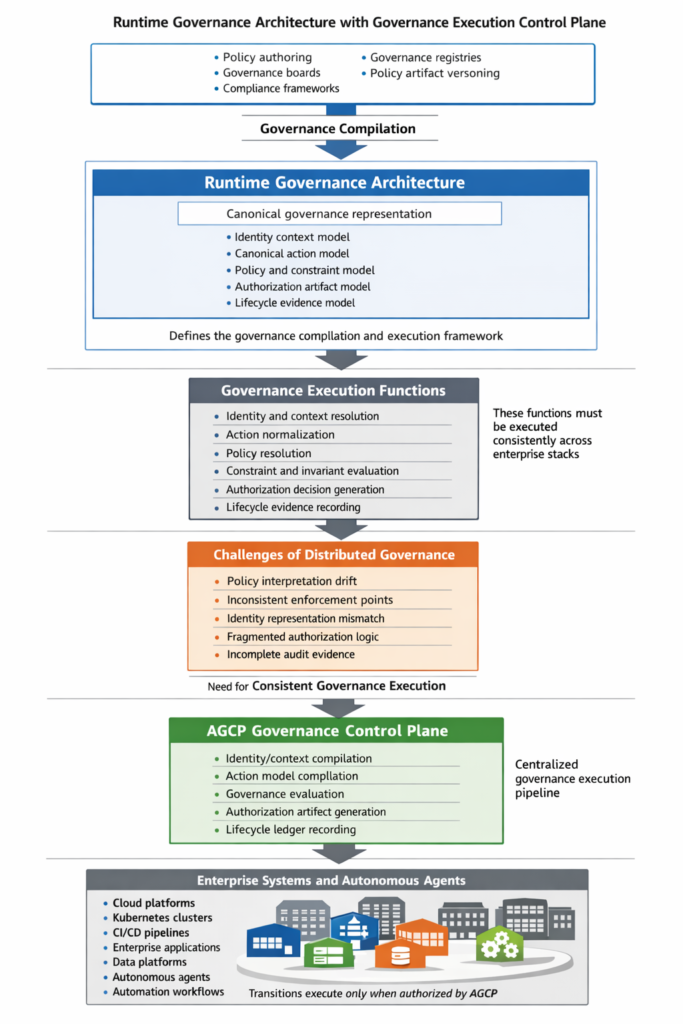
These functions address a structural gap between governance intent and operational execution: policies can define what should happen, but runtime systems need mechanisms that determine whether a specific consequential action may actually proceed.
From Governance Intent to Controlled Execution
AGCP operates within a broader runtime-governance architecture that separates governance intent, machine-evaluable governance representation, deterministic runtime evaluation, and operational execution.
Prior authorization is not automatically perpetual execution authority. If governing conditions can change, authorization must remain valid when the proposed action reaches the execution or commit boundary.
Make Runtime Governance Capability Assessable
AGCP separates product deployment, assessment status, Registry publication, capability coverage, human verification, and conformance depth so that each claim remains specific and bounded.
AGCP Runtime deployment and AGCP assessment are separate pathways. Organizations may deploy or pilot AGCP Runtime without first purchasing an assessment, and independently implemented systems may be assessed without using AGCP Runtime.
Registry Assessment
Automated, evidence-based assessment of one defined system against applicable AGCP requirements within an agreed assessment scope.
- assessment findings
- governance capability classification
- Capability Profile
- defined assessment scope
- basis for optional Registry publication
Optional Registry Publication
Eligible assessed systems may elect public Registry publication after assessment.
Registry records provide approved assessment, capability, scope, and verification metadata. The underlying assessment report and technical evidence remain under the assessed organization’s control.
Human Verified Assessment
A deeper control-level technical assessment using private AI-assisted source-code semantic analysis, supporting technical evidence, customer-assisted verification, and human adjudication.
Typical completion is approximately 2–3 weeks after a complete submission, depending on scope, complexity, evidence availability, and customer responsiveness.
Public Registry publication is optional. Assessment status and Registry status are separate from the governance capabilities demonstrated within the assessment scope.
Inaugural AGCP Registry Publication — October 2026
The inaugural AGCP Founders Cohort is complete. All ten positions have been filled, and the cohort is scheduled for publication through the AGCP Governance Registry in October 2026.
Organizations outside the Founders Cohort may now pursue Registry Assessment, Human Verified Assessment, and other applicable AGCP assessment pathways independently.
Open AGCP Architecture. Deployable AGCP Runtime.
AGCP remains implementation-agnostic. Organizations may implement AGCP semantics independently, use third-party technologies, or deploy the commercial AGCP Runtime product.
AGCP Architecture & Conformance
- open AGCP specification
- public normative requirements
- implementation-independent semantics
- independent implementation pathways
- assessment without AGCP Runtime
AGCP Runtime Product
- deployable deterministic control plane
- enterprise runtime integration
- commit-boundary governance
- governance decision evidence
- pilot-to-production deployment pathway
AGCP Runtime is not required for AGCP conformance. The commercial runtime product provides one implementation path; independently developed implementations may also be evaluated against applicable AGCP requirements.
Training, Research, and Open Resources
AGCP provides open specifications, research papers, normative requirements, architecture materials, training resources, and assessment guidance for practitioners working with runtime governance.
Runtime Governance Training
Free self-paced learning through orientation materials, six core readings, video briefings, knowledge checks, and an integrated learning guide.
Explore TrainingRequirements Catalog
Review the normative AGCP runtime-governance requirements used to evaluate lifecycle, execution, evidence, authority, continuity, multi-agent, and control-plane integrity.
View RequirementsResearch & Resources
Access specifications, architectural papers, semantic models, implementation guidance, diagrams, and supporting governance materials.
Explore ResourcesRuntime Governance Architecture & Conformance Alignment
AGCP Advisory Services support organizations designing, implementing, evaluating, and operationalizing deterministic runtime governance across AI-enabled, agentic, autonomous, and multi-agent systems.
Advisory Services are optional. Organizations may pursue an AGCP Runtime Pilot, production licensing, or AGCP assessment without first purchasing advisory services.
Architecture Review
Evaluate execution boundaries, authority, admissibility, authorization, evidence, and governance checkpoints.
Implementation Review
Examine implementation artifacts, authorization flows, code paths, evidence generation, and runtime-governance behavior.
Assessment Preparation
Identify gaps and prepare architecture, evidence, traces, and technical personnel for an applicable AGCP assessment pathway.
Move from Governance Intent to Governed Execution
Deploy AGCP Runtime around a consequential AI workflow, validate it through a $50,000 Enterprise Runtime Pilot, and move successful deployments into a $200,000-per-year production-domain license. The open AGCP architecture, requirements, assessments, Registry, training, and advisory ecosystem remain available alongside the commercial runtime product.