Runtime Governance Architecture for AI and Autonomous Systems
AGCP (AI Governance Control Plane) is a deterministic runtime governance architecture designed to mediate AI-enabled execution across enterprise operational environments.
AGCP evaluates proposed operational transitions against synchronized runtime conditions before consequential execution is permitted to bind to enterprise operational state.
Authorization resolves dynamically at runtime execution boundaries using admissibility evaluation, policy constraints, operational-state qualification, and synchronized governance context.
The framework introduces:
- governance overlays
- execution-bound authorization
- runtime admissibility enforcement
- deterministic orchestration checkpoints
- synchronized governance state
- evidence-centric operational assurance
AGCP was developed to address structural governance gaps emerging from autonomous, probabilistic, and multi-agent operational systems.
THE GOVERNANCE PROBLEM
Static Governance Is Insufficient
Traditional governance approaches primarily operate:
- before execution
- after execution
- outside operational runtime flows
These models increasingly struggle to govern systems capable of:
- autonomous orchestration
- dynamic prioritization
- multi-agent coordination
- infrastructure interaction
- cross-domain operational decision-making
As AI systems gain operational authority, governance must evolve from:
- static oversight
to:
- runtime execution mediation
RUNTIME GOVERNANCE
Governance as Active Runtime Mediation
AGCP treats governance as:
- an operational control layer
- not merely a reporting or audit function
The framework establishes deterministic governance checkpoints capable of evaluating:
- execution authority
- policy admissibility
- governance constraints
- operational risk state
- evidence continuity
- synchronized runtime conditions
before operational actions are committed.
This enables governance enforcement directly within enterprise execution flows.
RUNTIME GOVERNANCE ARCHITECTURE
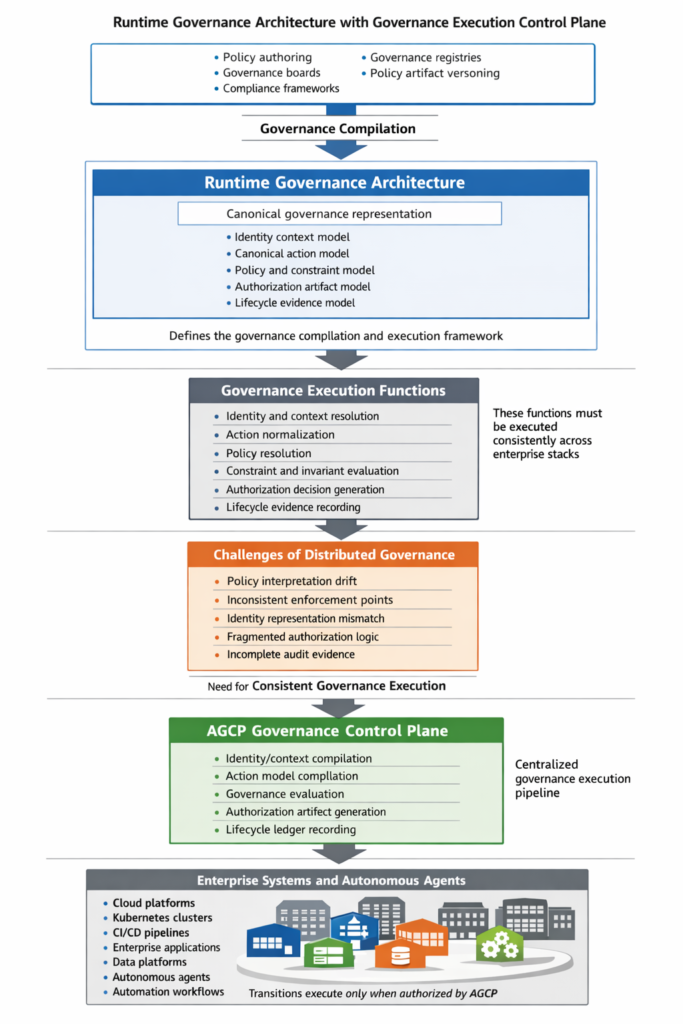
AGCP operates as a deterministic runtime execution-control architecture that compiles governance intent into machine-evaluable control semantics capable of mediating consequential execution across enterprise systems and autonomous operational environments. The architecture establishes synchronized operational state, canonical execution representations, admissibility evaluation, authorization mediation, and lifecycle evidence continuity across distributed domains.
CORE ARCHITECTURAL PRINCIPLES
Deterministic Governance Mediation
Governance decisions must be:
- reproducible
- attributable
- policy-bound
- operationally explainable
Execution-Bound Authorization
Authorization occurs at runtime execution boundaries rather than solely during static access provisioning.
Runtime Governance Synchronization
Governance mediation operates through synchronized runtime evaluation layers capable of enforcing deterministic execution semantics across distributed operational systems.
Runtime governance state remains continuously synchronized across:
- identity
- orchestration
- infrastructure
- execution
- resilience
- operational domains
This enables governance decisions to remain context-aware, operationally attributable, and execution-consistent under changing runtime conditions.
Evidence-Centric Assurance
Operational actions generate attributable governance evidence supporting:
- auditability
- replayability
- provenance continuity
- operational reconstruction
EXECUTION GOVERNANCE MODEL
EXECUTION GOVERNANCE MODEL
AGCP operates as a deterministic runtime execution-governance architecture responsible for mediating consequential operational transitions under current runtime conditions.
Rather than relying solely on:
- static approval workflows
- post-execution audit
- upstream authorization inheritance
AGCP evaluates whether proposed operational transitions remain admissible at the point where consequential execution attempts to bind to enterprise operational state.
The framework establishes runtime governance through:
- governance compilation
- canonical runtime-state evaluation
- admissibility determination
- execution-bound authorization
- policy enforcement mediation
- evidence continuity
- deterministic replayability
RUNTIME GOVERNANCE MEDIATION
At a high level, AGCP governance mediation includes:
- context acquisition
- canonical-state qualification
- runtime admissibility evaluation
- constraint and policy validation
- bind-time authorization
- execution-bound enforcement
- governance evidence generation
- cross-domain synchronization
- operational continuity and recovery coordination
This model enables deterministic runtime governance enforcement across AI-enabled enterprise and autonomous operational systems.
RUNTIME GOVERNANCE LIFECYCLE
At a high level, AGCP governance mediation includes:
- context acquisition
- state synchronization
- constraint evaluation
- admissibility determination
- execution authorization
- evidence generation
- cross-domain synchronization
- recovery and operational continuity
This model enables deterministic runtime governance enforcement across AI-enabled operational systems.
CONFORMANCE & ECOSYSTEM
Structured Runtime Governance Evaluation
AGCP Conformance Assessments provide structured evaluation of:
- governance maturity
- execution mediation integrity
- runtime authorization semantics
- evidence continuity
- operational governance synchronization
OPEN SPECIFICATION
Open Governance Architecture Initiative
AGCP is being developed as:
- an open specification
- an emerging governance ecosystem
- a runtime governance architecture initiative focused on operational assurance for AI-enabled systems
Selected governance architectures, runtime mediation methodologies, and conformance mechanisms are patent pending.
TOWARD OPERATIONALLY GOVERNED AI SYSTEMS
As autonomous systems continue expanding across enterprise environments, governance architectures must evolve beyond static oversight models toward deterministic runtime operational mediation.
AGCP represents one approach toward establishing that foundation.